
Most english pronunciation practice materials teach you the sounds, but they miss the bigger picture.
You’ve studied the rules and practiced the sounds. Heck, you’ve even memorized tongue twisters until your mouth felt like rubber.
But when you speak, something still feels… off.
Here’s the thing: I used to think pronunciation was just about getting individual sounds right. I’d repeat “ship” and “sheep” until I was blue in the face, convinced that mastering these distinctions would unlock fluent English. However, native speakers rarely focus on isolated sounds in real conversation. They use a completely different approach—one that most textbooks don’t teach.
The real problem? Most resources focus on what to pronounce (lists of sounds, endless rules) but ignore how native speakers actually use language. They skip the rhythm, the flow, the natural connections between words. It’s like learning to read music without ever hearing a song.
Table of Contents
- The Core Problem: Why English Sounds So Fast
- The 5 Hidden Habits for Elite English Pronunciation
- Your 7-Day English Pronunciation Practice Master Plan
- Start Your English Pronunciation Practice Journey Today
The Core Problem: Why English Sounds So Fast
Have you ever listened to native English speakers and thought, “Why do they talk so fast?”
Here’s a secret: they’re not actually speaking faster than you. They’re just using different patterns.
English is what linguists call a stress-timed language. This means native speakers don’t give equal weight to every syllable. Some words get stressed (pronounced louder and longer), while others get compressed or even partially disappeared. Therefore, when you try to pronounce every word clearly and evenly, you actually sound less natural.
Think of it like music. If you play every note with the same volume and length, it sounds robotic. Similarly, natural English has a rhythm—a bounce, a beat. Once you learn this rhythm, suddenly everything clicks into place. This is the foundation of smart english pronunciation practice.
The barrier isn’t the individual sounds. It’s the connection, the flow, the music of the language.
The 5 Hidden Habits for Elite English Pronunciation
Habit 1: The ‘Bouncy’ Beat – Mastering Stress and Rhythm
Imagine English as a drumbeat. Some beats are strong (BOM), others are weak (bom).
For example, look at this sentence: “I WANT to GO to the STORE.”
Native speakers emphasize “WANT,” “GO,” and “STORE” (content words) while quickly gliding over “I,” “to,” “the” (function words). This creates a natural rhythm that makes speech easier to understand.
Why sentence stress matters:
Content words (nouns, verbs, adjectives, adverbs) carry the meaning of your message. Function words (articles, prepositions, pronouns) just connect ideas. Therefore, stressing content words helps listeners catch your main points instantly.
Your action step:
Find a podcast transcript or song lyrics. Mark which words should receive stress. Then, practice reading aloud while exaggerating the stressed words. It might feel strange at first, but this habit dramatically improves your natural flow.
Furthermore, don’t forget the power of pausing. Native speakers pause at natural breaks (between clauses, before important points). These pauses give listeners time to process information and make your speech clearer.
Pro tip: Record yourself reading a paragraph twice—once with even stress, once with natural stress. Listen to the difference. You’ll immediately hear which version sounds more authentic.
Habit 2: The Sound Merge – The Power of Connected Speech
Here’s something that shocked me when I first discovered it: native speakers don’t pronounce every word separately.
They blend sounds together through connected speech. This includes techniques like linking (connecting the end of one word to the beginning of the next) and elision (dropping certain sounds in rapid speech).
Common examples:
- “Want to” becomes “wanna”
- “Going to” becomes “gonna”
- “Next time” sounds like “nex’ time” (the ‘t’ disappears)
- “Old man” becomes “ol’ man” (the ‘d’ vanishes)
The /t/ and /d/ sounds are especially prone to disappearing in fast, casual speech. Also, when a word ends with a consonant and the next word starts with a vowel, native speakers naturally link them: “an apple” sounds like “an-napple.”
Your action step:
Watch a short YouTube video or news clip. Listen specifically for moments where sounds connect or disappear. Shadow the speaker (repeat immediately after them) three times, focusing on mimicking these connections rather than individual words.
Movies are actually perfect for practicing connected speech because actors use natural rhythm and intonation. Check out our Learn English with Movies: 30-Day Challenge for step-by-step immersive practice techniques that make learning fun.
Once you start noticing connected speech, you’ll hear it everywhere. Moreover, your listening comprehension will improve dramatically because you’ll finally understand why native speakers sound so different from your textbook recordings.
Habit 3: The ‘Mouth Gymnastics’ – Vowel Accuracy
Among the 44 sounds in English pronunciation, vowels cause the most confusion for learners.
Why? Because many languages have only 5-7 vowel sounds, while English has around 20 (depending on the accent). This means your mouth needs to make subtle movements you’ve never practiced before.
The key isn’t memorizing all 44 sounds. Instead, focus on minimal pairs—words that differ by only one vowel sound. These pairs reveal the exact mouth positions that separate one vowel from another.
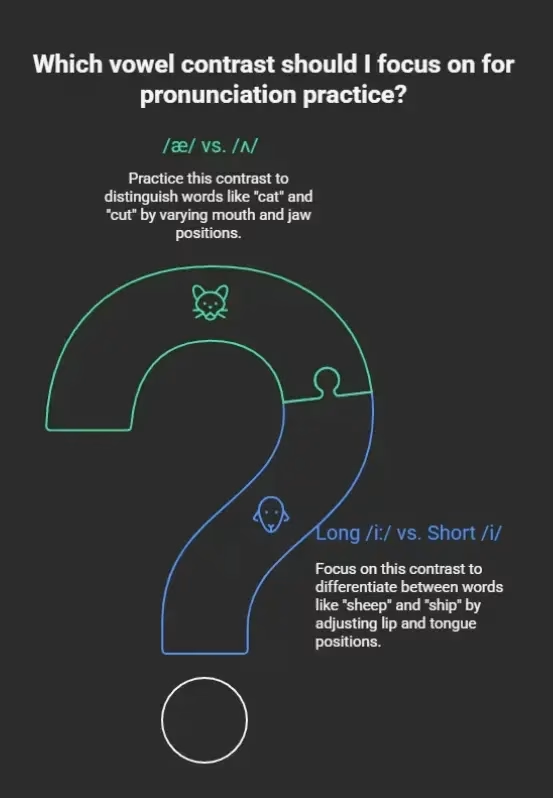
The two most crucial vowel contrasts:
1. Long /i:/ vs. Short /ɪ/
- “Sheep” (/i:/) – your lips stretch wide, tongue high
- “Ship” (/ɪ/) – lips more relaxed, tongue slightly lower
2. /æ/ vs. /ʌ/
- “Cat” (/æ/) – mouth open wide, jaw dropped
- “Cut” (/ʌ/) – mouth neutral, jaw relaxed
These small differences change meaning completely. Therefore, focusing your english pronunciation practice on these pairs gives you maximum impact with minimum effort.
Your action step:
Practice five minimal pairs daily. Record yourself saying each pair, then compare with a native speaker. Pay attention to how your mouth feels different for each vowel sound. Use a vowel chart or diagram to visualize tongue position—this makes the abstract concept concrete.
Additionally, online pronunciation tools can provide instant feedback on your vowel accuracy. Many apps show visual representations of your sound waves compared to native speakers.
Habit 4: Pitch Control – The Emotion of Intonation
Words aren’t just sounds. They’re music.
English intonation—the rise and fall of your voice pitch—completely changes meaning and emotion. This is why many learners sound monotone or robotic even when their individual sounds are perfect.
Basic intonation patterns:
Rising intonation (pitch goes up at the end):
- Yes/no questions: “Are you coming?” ↗
- Surprise: “Really?” ↗
- Lists (except the last item): “I bought apples, oranges, and bananas.” ↗ ↗ ↘
Falling intonation (pitch goes down):
- Statements: “I’m going home.” ↘
- Wh-questions: “Where are you going?” ↘
- Commands: “Close the door.” ↘
But here’s where it gets interesting: the same sentence with different intonation expresses completely different emotions.
“That’s interesting.” ↘ (genuine interest)
“That’s interesting.” ↗ (skepticism or sarcasm)
Your action step:
Take any script—a movie dialogue, a TED Talk transcript—and read it aloud twice. First, read it as an excited, happy person. Then read it as a bored, uninterested person. Notice how your pitch naturally changes to match the emotion.
Struggling to express emotions naturally in English? Learning to think in English helps you connect intonation with genuine feeling, rather than just mimicking sounds. Our 7 powerful strategies guide covers emotional expression techniques that make your speech authentic.
This exercise trains your brain to connect emotion with intonation automatically. Furthermore, it makes your speech more engaging and authentic.
Habit 5: Echo and Shadow – Intensive Immersion Technique
After teaching English pronunciation for years, I’ve discovered one method that consistently produces the fastest results: shadowing technique.
Shadowing means listening to native speech and repeating it immediately—sometimes even speaking simultaneously with the recording. This technique forces your brain to process rhythm, intonation, and connected speech all at once. It’s the most efficient english pronunciation practice method available today.
Why shadowing works:
- It trains your muscle memory for natural speech patterns
- It improves listening comprehension simultaneously
- It exposes you to authentic English (not textbook English)
- It’s fun and engaging (no boring drills)
Your action step:
Find a 30-60 second clip from a speaker you admire—a YouTuber, a podcast host, a movie character. Follow this three-step process:
- Listen: Play the clip and just absorb the rhythm and melody
- Echo: Pause after each sentence and repeat immediately
- Shadow: Play the clip again and speak along with it simultaneously
Here’s the crucial part: don’t just focus on the words. Focus on the music—the rhythm, the pitch changes, the speed variations. Try to become that speaker for those 60 seconds.
This technique directly addresses the question “Which method improves pronunciation?” by combining all five habits into one powerful practice. Moreover, it’s the closest thing to immersion without actually living in an English-speaking country.
Your 7-Day English Pronunciation Practice Master Plan
Theory is useless without action. That’s why this english pronunciation practice plan focuses on daily, hands-on tasks.
The Complete Weekly Roadmap
| Day | Focus Habit | Actionable Task | Practice Tool |
|---|---|---|---|
| Day 1-2 | Habit 1 (Stress/Rhythm) | Choose 5 sentences from a song or speech. Identify stressed words and practice saying them with exaggerated emphasis. | Lyrics video, podcast transcript, or movie subtitles |
| Day 3-4 | Habit 2 (Connected Speech) | Find a short news clip (2-3 minutes). Listen for three examples of linked or dropped sounds. Shadow the entire clip three times. | BoldVoice app, YouTube pronunciation channels, or BBC Learning English |
| Day 5 | Habit 3 (Vowel Sounds) | Practice 5 minimal pairs (pull/pool, bed/bad, ship/sheep, etc.). Record yourself and compare with native speakers. | Online minimal pair generators, Forvo.com for native pronunciations |
| Day 6 | Habit 4 (Intonation) | Choose one script and read it aloud expressing different emotions (happy, sad, angry, excited). Notice how your pitch naturally changes. | Movie scripts, TED Talk transcripts, or dialogue from TV shows |
| Day 7 | Synthesis (All Habits) | The Grand Challenge: Shadow a complete 2-minute clip while consciously applying all five habits—stress, linking, vowels, and intonation. | Any authentic English content: TED Talks, interviews, documentary clips |
How to Get Maximum Results
Important note: Consistency beats perfection. Even 10-15 minutes daily following this plan will produce noticeable results within one week. Also, adjust the difficulty based on your current level—beginners might start with slower content, while advanced learners can tackle faster, more complex material.
Want to expand your vocabulary while practicing pronunciation? Check out our Essential English Starter Kit – it includes an engaging storybook with vocabulary sections, plus comprehensive guides like Word Power Made Easy and Grammar Made Simple. Perfect for building a strong foundation alongside your pronunciation practice.
Making It a Habit
After completing this plan, repeat it with different content. The key is variety—different accents, different topics, different speaking styles. This trains your ear and mouth for real-world English diversity.
FAQ: Answering Your Top Pronunciation Questions
Based on research and practical experience, the most effective english pronunciation practice combines shadowing technique with focused skill work. shadowing technique (Habit 5) produces the fastest results because it trains multiple skills simultaneously. However, combining shadowing with focused practice on your weak areas (stress, vowels, or intonation) creates the most effective approach.
Think of shadowing as the main dish and the other four habits as ingredients that make it work better.
The five habits we covered are actually modern pronunciation rules:
1. Stress content words more than function words
2. Link sounds between words in connected speech
3. Master key vowel distinctions through minimal pairs
4 Use appropriate intonation to match your meaning and emotion
5. Practice through shadowing to integrate everything naturally
These rules focus on usage rather than theory, which makes them more practical for real conversation.
Tongue twisters are fun tools for practicing specific challenging sounds:
1. “Peter Piper picked a peck of pickled peppers” – Focuses on /p/ and /b/ sounds (plosives)
2. “She sells seashells by the seashore” – Practices /s/ and /ʃ/ distinction
3. “Red leather, yellow leather” – Challenges the /r/ and /l/ sounds plus vowel transitions
4. “Thirty-three thieves thought they thrilled the throne” – Masters the tricky /θ/ sound (th)
5. “How much wood would a woodchuck chuck” – Works on /w/ and /ʌ/ vowel sounds, Our viral Reel on Instagram on this, Check Here.
Use these for warm-ups, but remember: they’re supplements, not substitutes for real conversation practice.
Now let’s cover the practical details about timing and tools
With consistent daily practice using the methods above, most learners notice significant improvement within 2-4 weeks. However, reaching native-like pronunciation typically requires 6-12 months of dedicated practice.
The good news? You don’t need perfect pronunciation to communicate effectively. Focus on clarity and confidence first, then refinement comes with time.
Several excellent resources can support your practice:
1. BoldVoice: AI-powered feedback on your pronunciation
2. YouGlish: Shows real videos of native speakers using specific words
3. Forvo: Database of native speaker pronunciations from multiple accents
4. ELSA Speak: Focuses on American English accent training
5. British Council Sounds Right: Excellent for British English pronunciation
For structured learning materials, check out our store at store.clipyourenglish.com – we offer premium ebooks, pronunciation workbooks, and complete practice systems with step-by-step guidance.
Additionally, free YouTube channels like Rachel’s English and English with Lucy provide high-quality pronunciation lessons without cost.
Start Your English Pronunciation Practice Journey Today
Here’s what I want you to remember: pronunciation isn’t about perfection. It’s about clarity, confidence, and connection.
You don’t need to eliminate your accent completely (accents are beautiful!). You just need to develop habits that make you easily understood and natural-sounding.
The five habits we covered today—stress patterns, connected speech, vowel accuracy, intonation control, and shadowing—form the foundation of natural English pronunciation. These aren’t theoretical concepts. They’re practical tools you can start using immediately.
Your next steps:
- Bookmark this page for your ongoing english pronunciation practice reference
- Start the 7-day practice plan today (not tomorrow—today!)
- Focus on one habit at a time rather than overwhelming yourself
- Record your voice weekly to track your progress
- Be patient with yourself and celebrate small improvements
Remember, every native speaker you admire started somewhere. They practiced, they made mistakes, they sounded awkward at first. The difference between them and learners who give up? They kept going.
Your journey to flawless English pronunciation starts with a single sentence. So pick up your phone, find a 30-second clip you love, and start shadowing right now.

The English-speaking world is waiting to hear your voice—your real, confident, natural voice. Go show them what you’ve got.